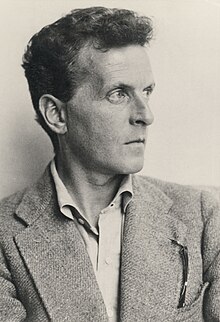
 Ludwig Wittgenstein: Logikai-filozófiai értekezés (TRACTATUS LOGICO-PHILOSOPHICUS)
Barátom, David H. Pinsent emlékének
„és mindazt, mit tud az ember, s nemcsak üres zaj a fülben, három szóban lehet elmondani.” Kürnberger
| 1|2|3|4|5|6 | magyar szöveg |
Tractatus: English text
PhI | Tractatus:




|
|---|---|---|
| 1. | A világ mindaz, aminek esete fennáll.* | The world is everything that is the case.* |
| 1.1 | A világ tények és nem dolgok összessége. | The world is the totality of facts, not of things. |
| 1.2 | A világ tényekre oszlik. | The world divides into facts. |
| 2. | Aminek esete fennáll, a tény, nem más, mint a körülmények megléte. | What is the case, the fact, is the existence of atomic facts. |
| 2.1 | Mi képeket alkotunk magunknak a tényekről. | We make to ourselves pictures of facts. |
| 2.2 | A képben a leképezés logikai formája közös a leképezettel. | The picture has the logical form of representation in common with what it pictures. |
| 3. | A tények logikai képe a gondolat. | The logical picture of the facts is the thought. |
| 3.1 | A kijelentésben a gondolat érzékileg felfogható módon jut kifejezésre. | In the proposition the thought is expressed perceptibly through the senses. |
| 3.2 | A kijelentésben úgy fejeződhetik ki a gondolat, hogy a gondolat tárgyainak a kijelentésjel elemei felelnek meg. | In propositions thoughts can be so expressed that to the objects of the thoughts correspond the elements of the propositional sign. |
| 3.3 | Csak a kijelentésnek van értelme; csak a kijelentés összefüggésében van a névnek jelentése. | Only the proposition has sense; only in the context of a proposition has a name meaning. |
| 3.4 | A kijelentés egy helyet határoz meg a logikai térben. E logikai hely létét egymaga az alkotóelemek létezése, az értelemmel bíró kijelentés létezése biztosítja. | The proposition determines a place in logical space: the existence of this logical place is guaranteed by the existence of the constituent parts alone, by the existence of the significant proposition. |
| 3.5 | Az alkalmazott, a gondolt kijelentésjel a gondolat. | The applied, thought, propositional sign, is the thought. |
| 4. | A gondolat értelemmel bíró kijelentés. | The thought is the significant proposition. |
| 4.1 | A kijelentés a körülmények fennállását vagy fenn nem állását ábrázolja. | A proposition presents the existence and non-existence of atomic facts. |
| 4.2 | A kijelentés értelme a körülmények fennállásának és fenn nem állásának lehetőségeivel való megegyezésben, illetve meg nem egyezésében áll. | The sense of a proposition is its agreement and disagreement with the possibilities of the existence and non-existence of the atomic facts. |
| 4.3 | Az elemi kijelentések igazságlehetőségei a körülmények fennállásának, illetve fenn nem állásának lehetőségeit jelentik. | The truth-possibilities of the elementary propositions mean the possibilities of the existence and non-existence of the atomic facts. |
| 4.4 | A kijelentés az elemi kijelentések igazságlehetőségeivel való megegyezés, illetve meg nem egyezés kifejezése. | A proposition is the expression of agreement and disagreement with the truth-possibilities of the elementary propositions. |
| 4.5 | Most lehetségesnek látszik a legáltalánosabb kijelentésforma megadása: vagyis bármely szimbolikus nyelv összes kijelentésének leírása, mégpedig úgy, hogy minden lehetséges értelem olyan szimbólum által legyen kifejezhető, amelyre ráillik a leírás, és minden egyes szimbólum, amelyre a leírás ráillik, kifejezhessen valamely értelmet, ha a nevek jelentését megfelelő módon választják meg. Nyilvánvaló, hogy a legáltalánosabb kijelentésforma leírásának csak azt szabad leírnia, ami annak lényegéhez tartozik — hiszen másképp nem lenne a legáltalánosabb. Azt, hogy létezik általános kijelentésforma, bizonyítja az a tény, hogy nem lehetséges olyan kijelentés, amelynek formáját ne lehetett volna előrelátni (azaz megszerkeszteni). A kijelentés általános formája a következő: Ez meg ez az eset áll fenn. | Now it appears to be possible to give the most general form of proposition; i.e. to give a description of the propositions of some one sign language, so that every possible sense can be expressed by a symbol, which falls under the description, and so that every symbol which falls under the description can express a sense, if the meanings of the names are chosen accordingly. It is clear that in the description of the most general form of proposition only what is essential to it may be described—otherwise it would not be the most general form. That there is a general form is proved by the fact that there cannot be a proposition whose form could not have been foreseen (i.e. constructed). The general form of proposition is: Such and such is the case. |
| 5. | Minden kijelentés az elemi kijelentések igazságfüggvénye. (Az elemi kijelentés önmagának igazságfüggvénye.) | Propositions are truth-functions of elementary propositions. (An elementary proposition is a truth-function of itself.) |
| 5.1 | Az igazságfüggvényeket sorokba lehet rendezni. Ez az alapja a valószínűségelméletnek. | The truth-functions can be ordered in series. That is the foundation of the theory of probability. |
| 5.2 | A kijelentésstruktúrák belső viszonyban állnak egymással. | The structures of propositions stand to one another in internal relations. |
| 5.3 | Valamennyi kijelentés az elemi kijelentéseken végzett igazságműveletek eredménye. Az igazságművelet nem más, mint annak útja és módja, ahogy az elemi kijelentésekből az igazságfüggvény létrejön. Az igazságművelet lényegének megfelelően, ahogy az elemi kijelentésekből létrejön azok igazságfüggvénye, ugyanúgy keletkezik az igazságfüggvényekből egy új igazságfüggvény. Minden egyes igazságművelet az elemi kijelentések igazságfüggvényeiből megint az elemi kijelentések egy igazságfüggvényét állítja elő, azaz egy kijelentést. Az elemi kijelentésekkel végzett igazságműveletek eredményeivel végrehajtott bármely igazságmüvelet eredménye tehát az elemi kijelentésekkel végzett egyetlen igazságművelet eredményének is tekinthető. Minden egyes kijelentés az elemi kijelentésekkel végzett igazságmüveletek eredménye. | All propositions are results of truth-operations on the elementary propositions. The truth-operation is the way in which a truth-function arises from elementary propositions. According to the nature of truth-operations, in the same way as out of elementary propositions arise their truth-functions, from truth-functions arises a new one. Every truth-operation creates from truth-functions of elementary propositions another truth-function of elementary propositions, i.e., a proposition. The result of every truth-operation on the results of truth-operations on elementary propositions is also the result of one truth-operation on elementary propositions. Every proposition is the result of truth-operations on elementary propositions. |
| 5.4 | Itt mutatkozik meg, hogy „logikai tárgyak”, „logikai konstansok” (a Frege- és Russell-féle értelemben) nincsenek. | Here it becomes clear that there are no such things as “logical objects” or “logical constants” (in the sense of Frege and Russell). |
| 5.5 | Minden egyes igazságfüggvény a (– – – – –I) (ξ, . . . .) művelet elemi kijelentésekre való szukcesszív alkalmazásának eredménye. Ez a művelet tagadja a jobb oldali zárójelben levő összes kijelentést, és én e kijelentések tagadásának nevezem. | Every truth-function is a result of the successive application of the operation (– – – – – T)(ξ, ....) to elementary propositions. This operation denies all the propositions in the right-hand bracket and I call it the negation of these propositions. |
| 5.6 | Nyelvem határai világom határait jelentik. | The limits of my language mean the limits of my world. |
| 6. | Az igazságfüggvény általános formája a következő: [math]\displaystyle{ [ \bar{p}, \bar{\xi}, N (\bar{\xi}) ] }[/math]. Ez a kijelentés általános formája. | The general form of truth-function is: [math]\displaystyle{ [ \bar{p}, \bar{\xi}, N (\bar{\xi}) ] }[/math]. . This is the general form of proposition. |
| 6.1 | A logika kijelentései tautológiák. | The propositions of logic are tautologies. |
| 6.2 | A matematika egy logikai módszer. A matematika kijelentései egyenletek, tehát látszatkijelentések. | Mathematics is a logical method. The propositions of mathematics are equations, and therefore pseudo-propositions. |
| 6.3 | A logika vizsgálata minden törvényszerűség vizsgálatára kiterjed. És a logikán kívül minden véletlen. | Logical research means the investigation of all regularity. And outside logic all is accident. |
| 6.4 | Minden kijelentés egyenértékű. | All propositions are of equal value. |
| 6.5 | Egy olyan felelethez, amelyet nem lehet kimondani, nem lehet kimondani a kérdést sem. A rejtély nem létezik. Ha egy kérdést egyáltalán fel lehet tenni, akkor meg is lehet válaszolni azt. | For an answer which cannot be expressed the question too cannot be expressed. The riddle does not exist. If a question can be put at all, then it can also be answered. |
| 7. | Amiről nem lehet beszélni, arról hallgatni kell. | Whereof one cannot speak, thereof one must be silent. |